
As with so many other things in the New Testament, the events of Pentecost didn’t just come out of nowhere - they’re connected very deeply to the Old Testament.
Many people don’t realize that the feast of Pentecost didn’t begin in Acts 2 when the Holy Spirit descended upon the Apostles. In fact, it wasn’t originally a Christian feast, at all. Pentecost was a Jewish feast that had been around well over a thousand years.
Biblical Math
Also known as the Feast of Weeks because it was celebrated 7 weeks after Passover ( because 7x7=49…unless you use Common Core), the word Pentecost (pentēkostē) means “fiftieth” in Greek. (You begin counting toward Pentecost the day after Passover, which brings you to 50 days.)
Why 50? Because that’s when the people of Israel found themselves at the foot of Mt. Sinai after escaping slavery from the Egyptians. More particularly, it was the day they received the law of the covenant from God through Moses. In other words, it was the day the people of Israel became the people of God.
Thunder & Lightning, Very, Very Frightening
The story is that in Exodus 19 the Israelites arrived at Sinai not long after the Egyptian army had been swallowed up by the Red Sea. And God told Moses he was coming to visit the people in 3 days and that they were to ritually purify themselves in preparation. But in a theme common to the story of Israel (and all families with children) they didn’t do as commanded.
Even so, the Lord still showed up.
In verses 16-20 we read, “On the morning of the third day there were thunders and lightnings, and a thick cloud upon the mountain, and a very loud trumpet blast, so that all the people who were in the camp trembled. 17 Then Moses brought the people out of the camp to meet God; and they took their stand at the foot of the mountain. 18 And Mount Sinai was wrapped in smoke, because the Lord descended upon it in fire; and the smoke of it went up like the smoke of a kiln, and the whole mountain quaked greatly. 19 And as the sound of the trumpet grew louder and louder, Moses spoke, and God answered him in thunder. 20 And the Lord came down upon Mount Sinai, to the top of the mountain; and the Lord called Moses to the top of the mountain, and Moses went up.”
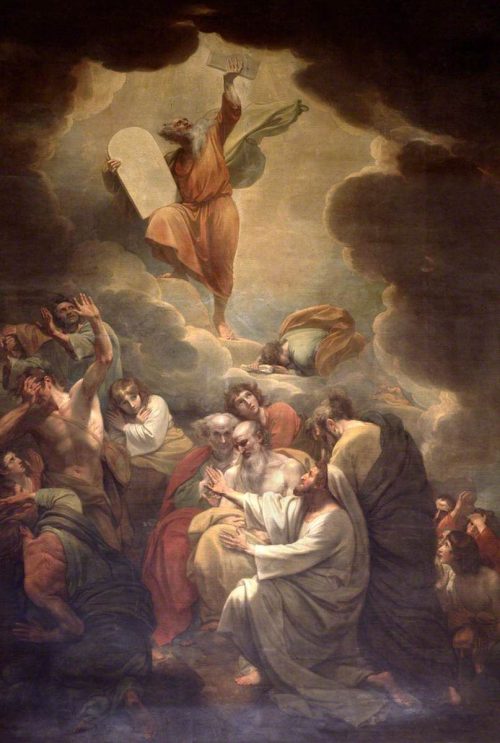
Once on the mountain, God told Moses to instruct the people not to come any closer because they had not purified themselves as instructed. Then God proceeded to give the 10 Commandments, as well as the law of the covenant.
Parallels
And while there are all kinds of things going on in this seminal story, let’s quickly point out some parallels between this whole scene at Mt. Sinai and what we read in Acts 2.
1. First of all, both events take place on mountains. God appeared to the Israelites at Mt. Sinai. Pentecost in Acts 2 took place in Jerusalem on Mt. Zion.
2. Secondly, both events had serious weather patterns. Sinai featured thunder and lightning, smoke and fire, and an earthquake. In Acts 2, we see something very similar with the sound of a rushing wind and the tongues of fire that descend upon the Disciples.
Also, the word “thunder” in Exodus can be translated as “voices” – “qol” in Hebrew. So you could say it is the sound of voices or the voice of God they heard on the mountain.
And to say it was not a demure voice would be the mildest of understatements. In fact, qol is the same word used to describe the sound made when God descended into the Garden of Eden after the sin of Adam and Eve. Again, it’s not just any ole’ voice. If you look at Psalm 29 you see the “qol”, or voice of the Lord, “breaks the cedars…flashes forth flames of fire…shakes the wilderness…makes the oaks to whirl and strips the forests bare.”
And what do the people in Jerusalem hear? The voices of the Apostles proclaiming the glory of the Lord in different languages. After what? After the tongues of fire descend upon them in a parallel way as to the descending of fire in Exodus 19.
3. Another parallel is that at Sinai the people were kept away from the fire on the mountain because they had not ritually purified themselves. But at Pentecost in Acts, the fire comes into their midst through the Apostles.
They don’t have to fear this time, especially since Christ has fulfilled the terms of the blood covenant they broke at Sinai (and all the other covenants). The curse of death has been lifted. We’ll touch more on that in a moment.
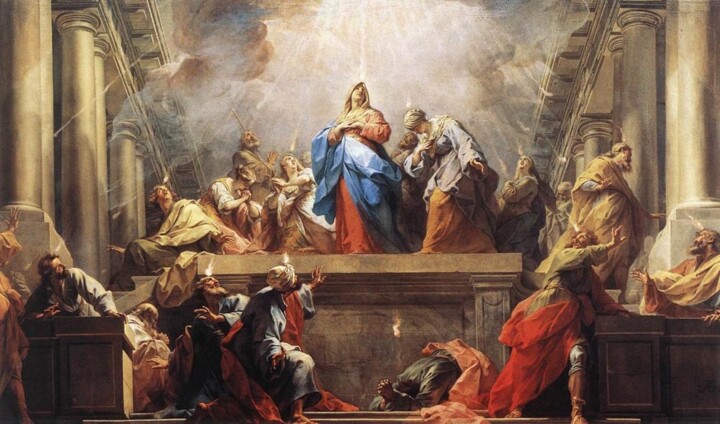
4. At Sinai the Israelites received a law written on stone – the Ten Commandments. At Pentecost the people received a law written on the human heart as foretold by the prophet Jeremiah hundreds of years earlier.
“Behold, the days are coming, says the Lord, when I will make a new covenant…not like the covenant which I made with their fathers when I took them by the hand to bring them out of the land of Egypt…But this is the covenant which I will make with the house of Israel after those days, says the Lord: I will put my law within them, and I will write it upon their hearts” (Jeremiah 31:31-33).
St. Thomas Aquinas says that the law of the New Covenant is nothing other than the grace of the Holy Spirit, which is exactly what showed up at Pentecost.
5. Finally, at Sinai, after the people received the law of the Lord, they swore a covenant with God. He said they would be his people if they would follow the commands he has given them. They received the law of the covenant and all the people declared, “All that the Lord has spoken we will do.”
The Covenant Sacrifice
Then something very important happens.
The acceptance of God by the people was ratified by a very strange event (to us moderns anyway) where Moses sacrificed two oxen and sprinkled half of the blood on the altar and half of the blood on the people. Why?
Basically, this was a very serious ceremonial sacrifice that often accompanied the swearing of these kinds of covenants between two parties (in this case, God and Israel).
Why the animal sacrifice? Because it symbolized what would happen to one of the parties if they broke the covenant...death...serious business, indeed.
The point of the entire episode is that the people of Israel swore they would be God’s people and then sealed their promise by participating in a blood sacrifice that bound them to him. In other words, they put themselves under a curse of death if they broke the covenant. And realize, this wasn’t some as-yet-unknown kind of thing. Everybody knew exactly what was going on. They knew the consequences of disobedience and breaking the covenant vow with God.
Experience God Like Never Before!
Longing for a deeper connection with God?
Sign up for 2 weeks FREE of Introduction to Real Prayer, the first course in the Science of Sainthood program! It's a couple weeks of spiritual teaching that'll leave you breathless!
CLICK HERE to start watching for FREE!
Playtime is Over
After the people swear the covenant, Moses goes back up Sinai into the fire of God. And we all know what happens. The people lose heart thinking Moses had been consumed by God in all the fire and such on the mountain and they convince Aaron to construct a golden calf to worship.
And by “worship”, we mean committing terrible sexual sin.
After offering sacrifice and feasting, Exodus 32:6 says the Israelites “rose up to play”, often seen as a euphemism for a sexual orgy. (It’s likely the golden calf represented Apis – an Egyptian god of fertility.)
So only 40 days after swearing a blood oath to God, they broke it. Moses comes down the mountain, sees what was going on and says, “Who is on the Lord’s side? Come to me” (Ex 32:76). His kinsmen, the Levites, come to his side and he commanded them to "slay the idolaters".
3,000 people died that day.
Obviously, that’s a bit heavy and the rubrics of ancient cultures often trouble a lot of people who read this passage. That said, what is often missed is that there is a great deal of mercy shown in this story. Remember that according to the terms of the covenant, all the Israelites should have died. After all, they corporately swore a blood oath that they would not worship other gods, and then barely a month later that’s exactly what they did. Yet, only 3,000 die.
So what does all of this have to do with the book of Acts?
If we fast-forward to Pentecost we'll see a similar scene play out with all the parallels we’ve already mentioned. But thankfully, there are differences.
Instead of calling out the sin of the people and then having to kill the idolaters as Moses did, Peter preaches the first homily in the history of the Church and the people are only “cut to the heart” says Acts 2:37.
“Brethren, what shall we do? And Peter said to them, ‘Repent, and be baptized every one of you in the name of Jesus Christ for the forgiveness of your sins; and you shall receive the gift of the Holy Spirit. 39 For the promise is to you and to your children and to all that are far off, every one whom the Lord our God calls to him.’ 40 And he testified with many other words and exhorted them, saying, ‘Save yourselves from this crooked generation.’ 41 So those who received his word were baptized, and there were added that day about three thousand souls. 42 And they devoted themselves to the apostles’ teaching and fellowship, to the breaking of bread and the prayers” (Acts 2:37-42).
The Numbers Don’t Lie
Something else...did you notice how many people came into the Church that day in Jerusalem? 3,000.
In other words, the 3,000 lost through the broken covenant at the foot of Sinai in the old Israel is restored to the New Israel – the Church - because of the New Covenant of Jesus Christ.
Pentecost is the birth of the new people of God. What was dead has been brought back to life through the power of the Holy Spirit – through the sacraments.
Why the sacraments? Because Peter tells them what they have to do to be saved - “Repent and be baptized.” Then we read that the people devoted themselves to “the apostles’ teaching and fellowship, to the breaking of bread and the prayers” (2:42). “Breaking of bread” is early Church language for the Eucharist.
So they were baptized, celebrated Mass and prayed. Sounds familiar, doesn't it?
The New People of God
So there you have it. The backstory of Pentecost in the book of Acts is the scene at Mt. Sinai way back at the birth of Israel as the people of God. And as Catholics, we are the new people of God. We are the New Israel, the restored and transformed kingdom of God in the New Covenant of Jesus Christ.
Thanks be to God for sending us the Holy Spirit! He brings us life. He manifests God in our presence. He continues the power of the resurrected and ascended Christ in our lives. Happy Feast of Pentecost!
God bless,
Matthew
P.S. Don't forget to sign up for your "no strings attached" 2-week free trial!
